

THE TIMES OF THE PRAYERS
Allaah, the Exalted revealed in Sooratul Baqarah, verse 238:
﴿ حَـٰفِظُوا۟ عَلَى ٱلصَّلَوَٰتِ ﴾
The verse means: “Perform the [five obligatory] prayers.”
The Messenger of Allaah, ﷺ, said:
خَمْسُ صَلَوَاتٍ كَتَبَهُنَّ اللَّهُ عَلَى الْعِبَادِ. مَنْ أَتَى بِهِنَّ لَمْ يُضَيِّعْ مِنْهُنَّ شَيْئًا اسْتِخْفَافًا بِحَقِّهِنَّ كَانَ لَهُ عِنْدَ اللَّهِ تَبَارَكَ وَتَعَالَى عَهْدٌ أَنْ يُدْخِلَهُ الْجَنَّةَ. وَمَنْ لَمْ يَأْتِ بِهِنَّ فَلَيْسَ لَهُ عِنْدَ اللَّهِ عَهْدٌ إِنْ شَاءَ عَذَّبَهُ وَإِنْ شَاءَ غَفَرَ لَهُ. رَوَاهُ أَحْمَدُ
It means: “There are five prayers that Allaah obligated the slaves to perform. Whoever performs them properly without belittling their obligation, Allaah promised to admit him into Paradise. Whoever leaves them out does not have a promise from Allaah to have Paradise without torture before. If He willed, He tortures him, and if He willed, He forgives him”. Narrated by Ahmad in his Musnad.
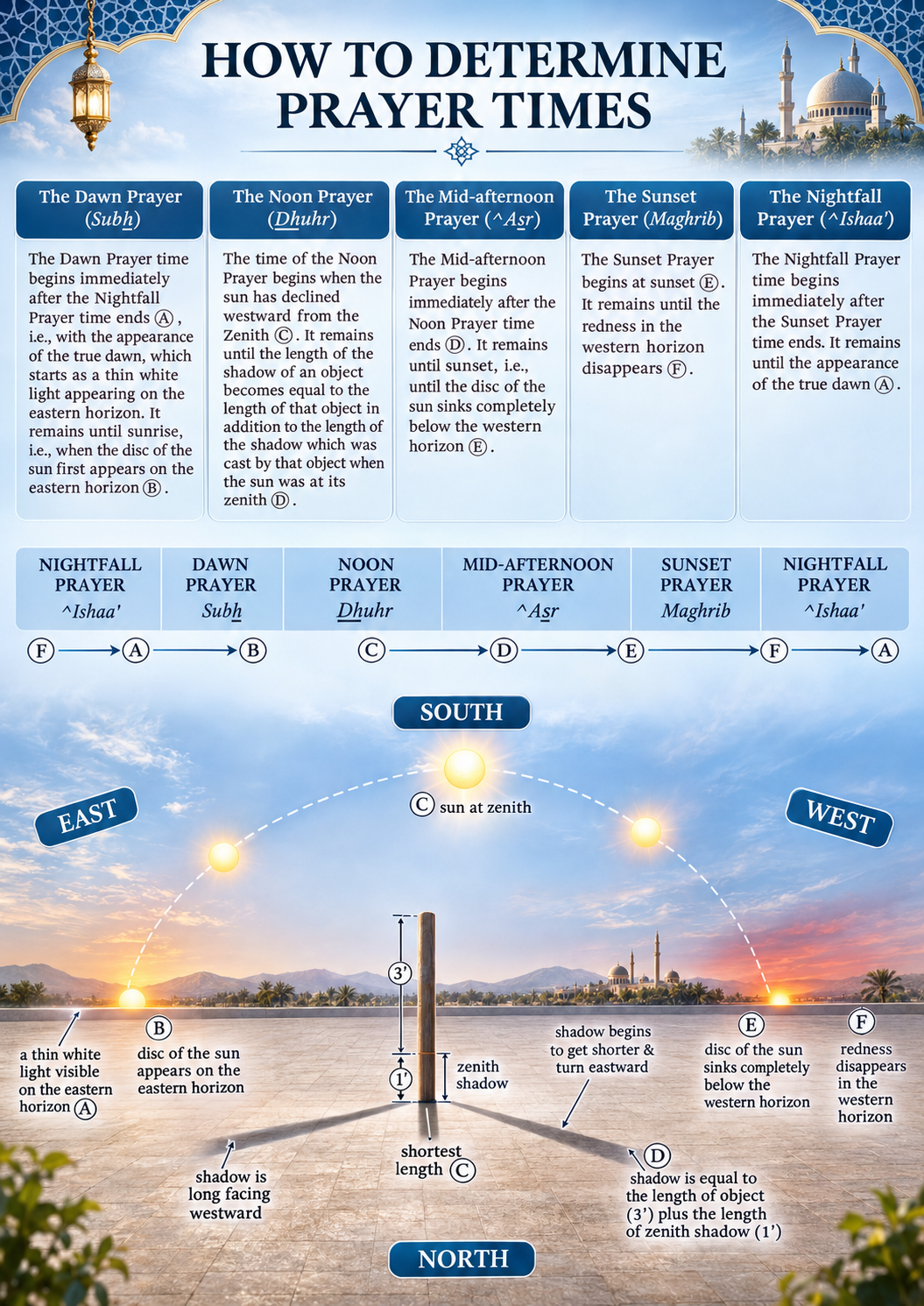
(1) The Dawn Prayer (Subh or Fajr) [two rak^ahs]:
Its time begins with the appearance of the true dawn, which is a white horizontal light that appears in the eastern horizon. Its time ends with sunrise.
(2) The Noon Prayer (Dhuhr) [four rak^ahs]:
Its time begins when the sun declines westward from the middle of the sky. It ends when the shadow of an object becomes equal to the length of that object plus the length of its shadow when the sun was at its zenith (dhillul-istiwaa’). The object could be a straight wooden stick that is plunged upright into a flat ground. If the sun moves westward from its zenith, the person will notice that the shadow will elongate and lean eastward. This is the sign that the Noon Prayer is in.
(3) The Afternoon Prayer (^Asr) [four rak^ahs]:
Its time begins after the time of Dhuhr ends, and it ends when the sun sets. Hence, if the shadow of an object becomes equal to the length of that object plus its length when the sun was at its zenith, then the time of Dhuhr ends and the ^Asr time begins.
(4) The Sunset Prayer (Maghrib) [three rak^ahs]:
Its time begins with sunset, i.e., the disappearance of the entire disk of the sun. It finishes when the redness (evening twilight) in the western horizon disappears.
(5) The Nightfall Prayer (^Ishaa’) [four rak^ahs]:
Its time begins with the disappearance of the redness in the western horizon and remains until the appearance of the true dawn.
Who Is Obligated to Pray and When?
Every pubescent, sane, and pure Muslim is obligated to perform these prayers within their times. A woman is considered pure (taahir) when she is clear of menstruation and post-partum bleeding.
It is unlawful, without an Islamic excuse, to perform these prayers ahead of their times or to delay them after their times have passed. Extreme sickness or traveling (with certain conditions) are examples of excuses for advancing or delaying the prayers.