

أَشْهَدُ أَنْ لَا إِلٰهَ إِلَّا اللهُ، وَأَشْهَدُ أَنَّ مُحَمَّدًا رَسُولُ اللهِ
Ash-hadu allaa ilaaha illa-llaah wa ash-hadu anna Muhammad-ar-Rasoolu-llaah
I testify that no one is God except Allaah, and I testify that Muhammad is the Messenger of Allaah.
Professing the Two Testifications of Faith:
It is obligatory upon one when embracing Islaam to utter the two testifications of faith immediately, while believing in their meaning, with the intention of becoming a Muslim. The two testifications of faith are: I testify that no one is God except Allaah, and I testify that Muhammad is the Messenger of Allaah.
As for the Muslim, he/she is obligated to recite the two testifications in every prayer for the validity of that prayer.
The Meaning of the Two Testifications of Faith:
Ash-hadu allaa ilaaha illa-llaah means: I know, believe in my heart, and declare with my tongue that nothing deserves to be worshipped except Allaah. That is, no one deserves my ultimate humbleness except Allaah, the Exalted.
Ash-hadu anna Muhammad-ar-Rasoolu-llaah means: I know, believe in my heart, and declare with my tongue that our master Muhammad, the son of ^Abdullaah, is the Messenger of Allaah to both the humans and jinn, Arabs and non-Arabs, and that he is truthful in all of what he conveyed from Allaah, the Exalted.
The Purpose of the Two Testifications:
What is meant by the two testifications is to confirm the Godhood of Allaah and negating it for other than Allaah. Along with that is to confirm the Prophethood of our Master Muhammad ﷺ.
A Detailed Explanation of the Two Testifications of Faith
The Meaning of Ash-hadu allaa ilaaha illallaah
The meaning of Ash-hadu allaa ilaaha illallaah is: “I know, believe, and declare that nothing is worshipped rightfully except Allaah”
Explanation:
This means that I firmly believe in my heart and declare with my tongue that nothing deserves to be worshipped except Allaah.
Some people worship things other than Allaah. For example, some people worship Buddha. Some people worship Prophet Jesus,^alayhis-salaam. Some people worship idols. Some people even worship the devil. All these things are worshipped unrightfully.
Allaah is the only One Who deserves to be worshipped. As defined by Imaam Taqiyyud-Deen As-Subkiyy (d. 756 AH), who was a well-known scholar of Fiqh, the fundamentals of the Religion, the interpretation of the Qur’aan, the Arabic language, and other sciences:
“Worship” is غَايةُ الخُضُوع والخُشُوع which means the ultimate submission and humbleness (to someone else).
Ar-Raaghib Al-Asbahaaniyy, the famous linguist, established the same definition for “worship” in his book, Mufradaatul-Qur’aan. So, worship is not simply ‘to call upon one’, ‘to fear one’, or ‘to be hopeful of one’. Rather, calling upon, fearing, or being hopeful of something entails worship only when linked to and associated with the ultimate submitting and humbling of oneself to that thing.
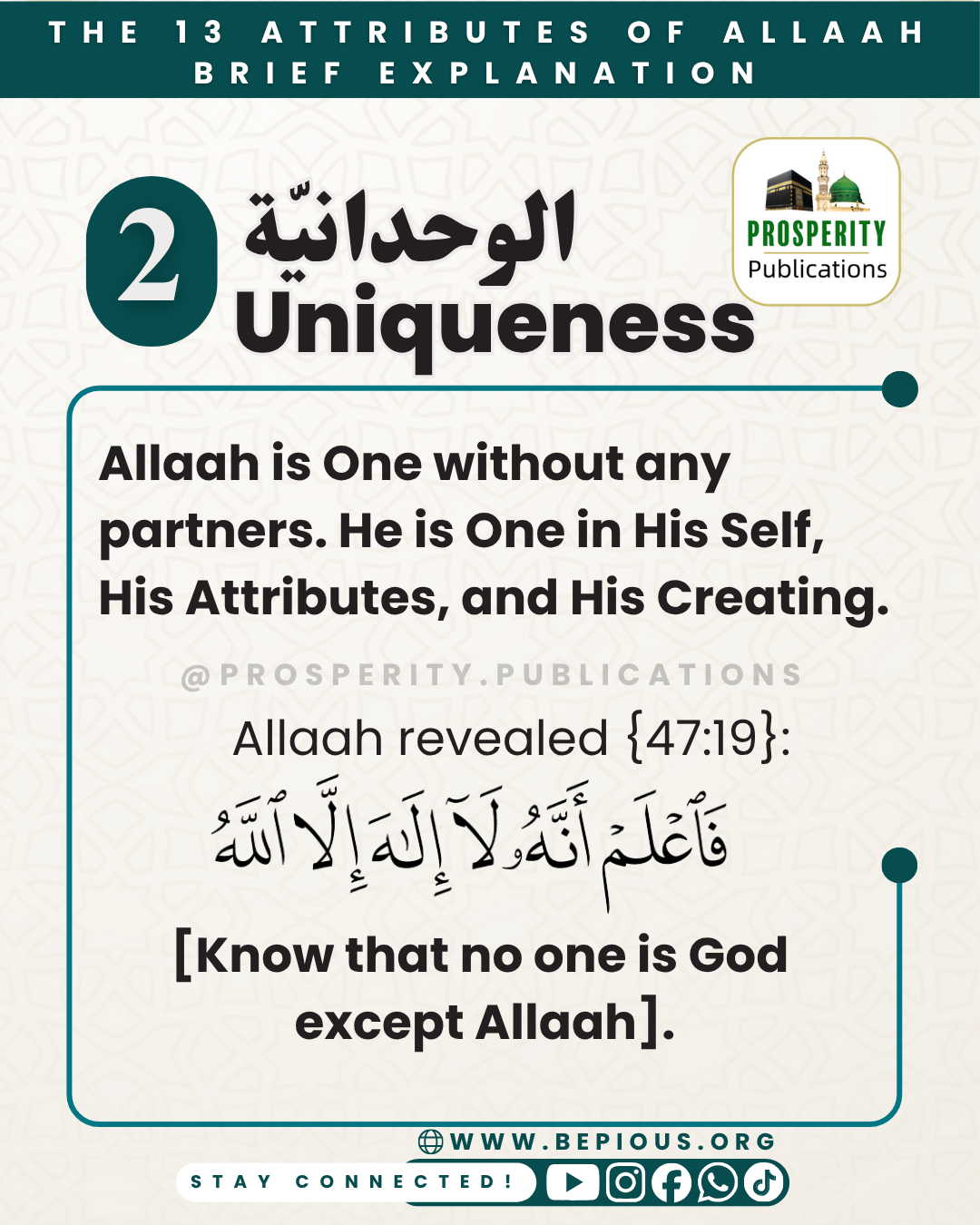
Allaah is One (Al-WaaHid)
Allaah is One (Al-Waahid)
Explanation:
Allaah is One (Waahid) means Allaah does not have a partner with Him in Godhood. ‘One’ here does not refer to a number.
Numbers can increase or decrease, be added to or subtracted from, and can be divided. For example, to say ‘one person’ does not mean that this person has no partners in humanity. Rather it is mentioned in the context of a number, i.e., he is one amongst others. Moreover, others are similar to him in certain aspects.
However, when we refer to Allaah as ‘One’ it means ‘the One Who does not have a partner’.
Imaam Aboo Haneefah (d. 150 AH), may Allaah raise his rank, said in Al-Fiqh Al-Akbar:
واللَّهُ واحدٌ لا من طريقِ العددِ ولكنْ مِن طريقِ أَنَّه لا شريكَ له
It means: “Allaah is One, not in the context of numbers, but in the context that He does not have any partner.”
Indivisible (Al-AHad)
Indivisible (Al-Ahad)
Explanation:
Some scholars said Al-Ahad has the same meaning as Al-Waahid, ie., there is no partner to Allaah in His Godhood. Others said Al-Ahad means ‘the One Who is indivisible, because He is not a body.’
He is neither a tangible (katheef body, which is grasped by the hand like humans, trees, and stones, nor an intangible (lateef) body that cannot be grasped by the hand like light, darkness, and the wind.
Without a beginning (Al-Awwal), Eternal (Al-Qadeem)
Without a beginning (Al-Awwal), Eternal (Al-Qadeem)
Explanation:
Al-Awwal and Al-Qadeem have the same meaning, which is ‘the One Whose Existence is without a beginning? His Existence is without a beginning means His Existence was not preceded by a state of non-existence.
Allaah alone is the One Who is attributed with this attribute. The existence of all things other than Allaah has a beginning. This matter is amongst the fundamentals of the Muslim’s belief. Anyone who believes otherwise is not a Muslim.
Alive (Al-Hayy)
Alive (Al-Hayy)
Explanation:
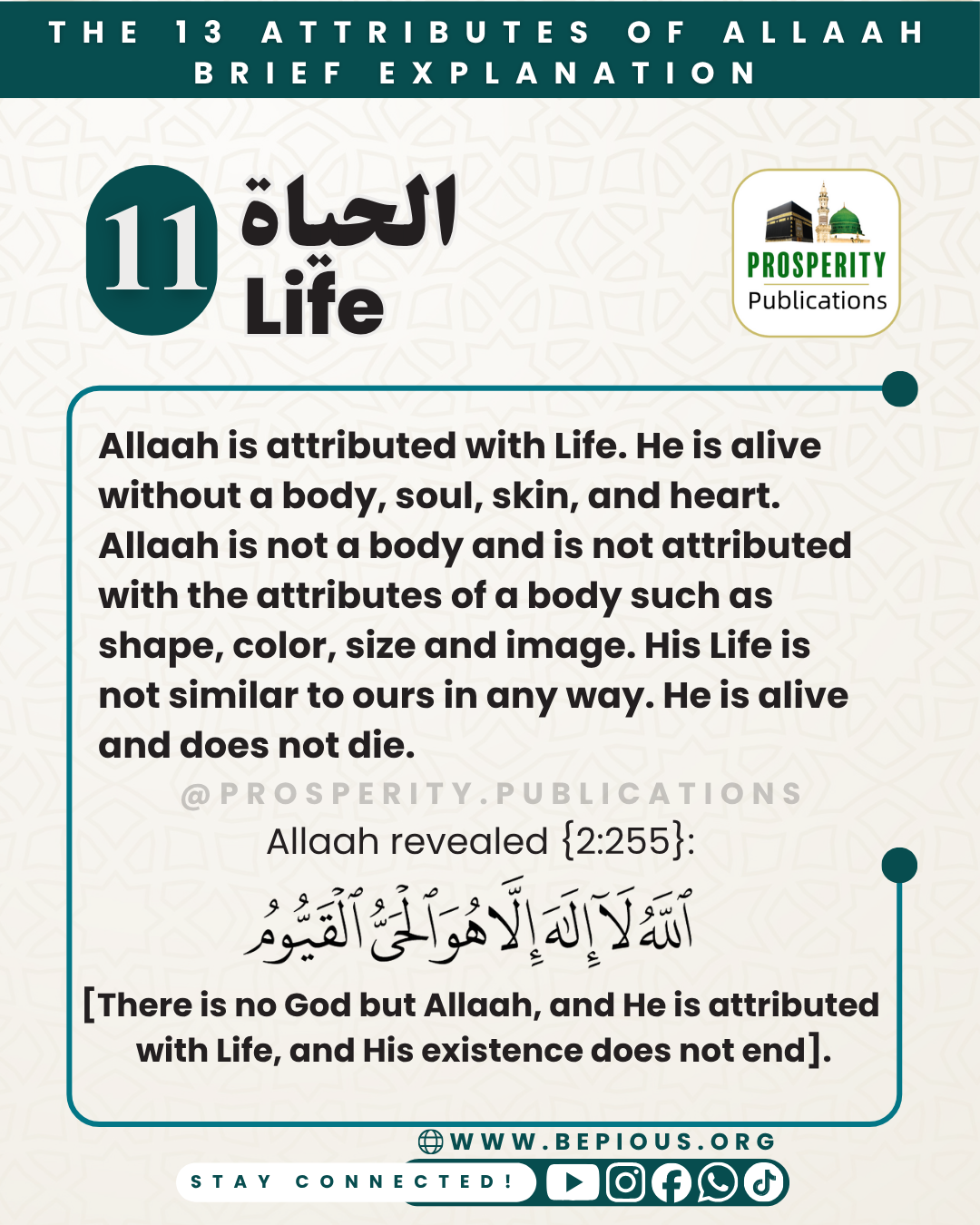
Allaah is Alive and His Life is without end. Allaah is attributed with an eternal and everlasting Life which does not resemble our life.
The One Whose Existence is without an end (Al-Qayyoom), Everlasting (Ad-Daa'im)
The One Whose Existence is without an end (Al-Qayyoom), Everlasting (Ad-Daa’im)
Explanation:
Here Al-Qayyoom and Ad-Daaim carry the same meaning. The Everlasting means ‘the One Whose Existence does not end.’
Allaah is Everlasting because that which ends must have had a beginning, and therefore must be a creation, and not the Creator.
The Creator (Al-KhaaliQ)
The Creator (Al-Khaaliq)
Explanation:
The Creator means ‘the One Who brings everything from the state of non-existence into the state of existence’ Nothing amongst the creations comes into existence except by the Creating of Allaah. The slave and his actions exist by the Creating of Allaah. All of us, including our doings, thoughts, and inclinations are created by Allaah.
The slave does not create anything. The slave does not bring anything from the state of non-existence into the state of existence. Rather, the slave only acquires his deeds. He directs his intention towards a particular deed, but Allaah is the One Who creates that deed Likewise, causes do not create any of their results.
The fire (cause) does not create burning (result). The knife (cause) does not create cutting (result). The bread (cause) does not create the feeling of satisfaction from hunger (result). Water (cause) does not create the quenching of thirst (result). The sun (cause) does not create warmth (result). Rather, these are causes followed by results and their Creator is Allaah.
At the point when the fire comes in contact with a certain combustible material, Allaah creates the burning in that material. Had Allaah not willed for that particular body to burn as a result of touching the fire, He would not have created the burning, and by consequence, it would not have burnt.
This was the case with Prophet Ibraaheem ^alayhis-salaam. He was put into a large, raging fire – yet he was not burned, because Allaah did not create the attribute of burning (cause) in that fire nor did He create the burning in Ibraaheem (result).
This case is also amongst the fundamentals of the creed. The one who believes that there is something or someone who shares with Allaah the attribute of Creating (of bringing things from non-existence into existence) is not a Muslim, even if he claims so.
The Sustainer (Ar-RaaziQ)
The Sustainer (Ar-Raaziq)
Explanation:
The Sustainer is the One Who gives the sustenance (rizq) to His slaves. Sustenance (rizq) includes all the things which give a benefit to the person – whether from a lawful or an unlawful source.
Knowledgeable (Al-^Aalim)
Knowledgeable (Al-^Aalim)
Explanation:
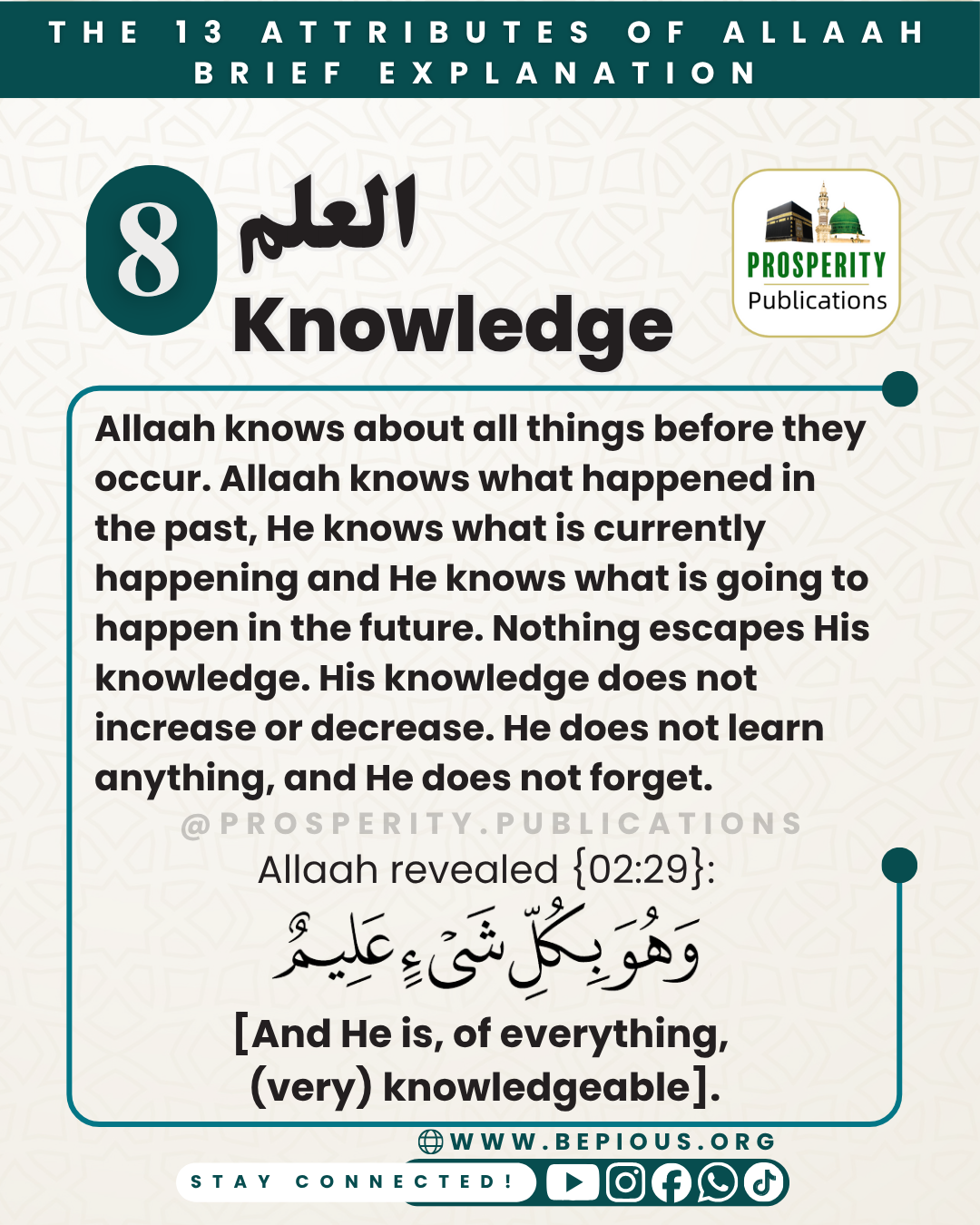
Allaah is the One Who knows everything. Allaah knows His Self, His Attributes, and His creations. Allaah knows the things before they happen.
Powerful (Al-Qadeer)
Powerful (Al-Qadeer)
Explanation:
Allaah is the One Who has Power over all things. He is not powerless over anything.
The One Who does whatever He wills, i.e., whatever Allaah willed to be shall be and whatever Allaah did not will to be shall not be
The One Who does whatever He wills, i.e., whatever Allaah willed to be shall be and whatever Allaah did not will to be shall not be.
Explanation:
This means that everything that Allaah willed in eternity to happen must happen in the way which Allaah knew and at the time which Allaah willed for it to occur. That which Allaah did not will in eternity to happen will never happen. Should an entire nation come together to inflict a harm on you that Allaah did not will to happen to you, it will not be able to harm you.
Likewise, should a nation come together to benefit you with a certain matter that Allaah did not will in eternity for you to benefit from, it will not be able to do so. This also is amongst the fundamentals of the proper belief. The Prophet, ﷺ, in several hadeeths (narrated by At–Tabariyy, Aboo Daawood, and others), explicitly mentioned that anyone who holds a creed contrary to this is not a Muslim.
No one can evade sinning except with Allaah's protection and no one has the ability to obey except with Allaah's help
No one can evade sinning except with Allaah’s protection and no one has the ability to obey except with Allaah’s help.
Explanation:
لا حَوْلَ وَلا قُوَّةَ إِلا بِاللّه
“Laa hawla walaa quwwata illaa billaah” is a statement that the Prophet, ﷺ, taught us to say.
As Aboo Ya^laa Al-Mawsiliyy related, the Prophet, ﷺ, explained this statement to mean: “Without Allaah’s protection no one can evade sinning, and without Allaah’s help no one has the strength to obey Him.”
Allaah is attributed with all proper perfection and is clear of all imperfection
Allaah is attributed with all proper perfection
Explanation:
Allaah is attributed with all the perfect attributes that befit Him. Here the author specified befitting perfect attributes, because amongst the perfect attributes there are those which are perfect in relation to mankind, but are imperfect when attributed to Allah. Some examples are brilliance, intellect, nice voice, and strength of body. When attributed to a creature, these are attributes of perfection. However, they are not befitting to attribute to the Creator.
and is clear of all imperfection
Explanation:
This means that Allaah is clear of any of the attributes of the creation, such as bodily characteristics, color, shape, motion, and stillness. This is why the People of Truth, Ahl-us-Sunnah wal-Jamaa^ah, said, “Allaah exists without a place,” because the one who exists in a place must have a limit, and everything that has a limit is in need of one who specified it with that limit.
Whatever is in need certainly is not the Creator. This is why Allaah is clear of existing in any place or any direction. We do not say Allaah inhabits the sky. We do not say that Allaah exists in the direction of above. We do not say that Allaah exists in all places, or everywhere. Rather, Allaah exists and He does not resemble other things that exist. Hence, Allaah exists without a place.
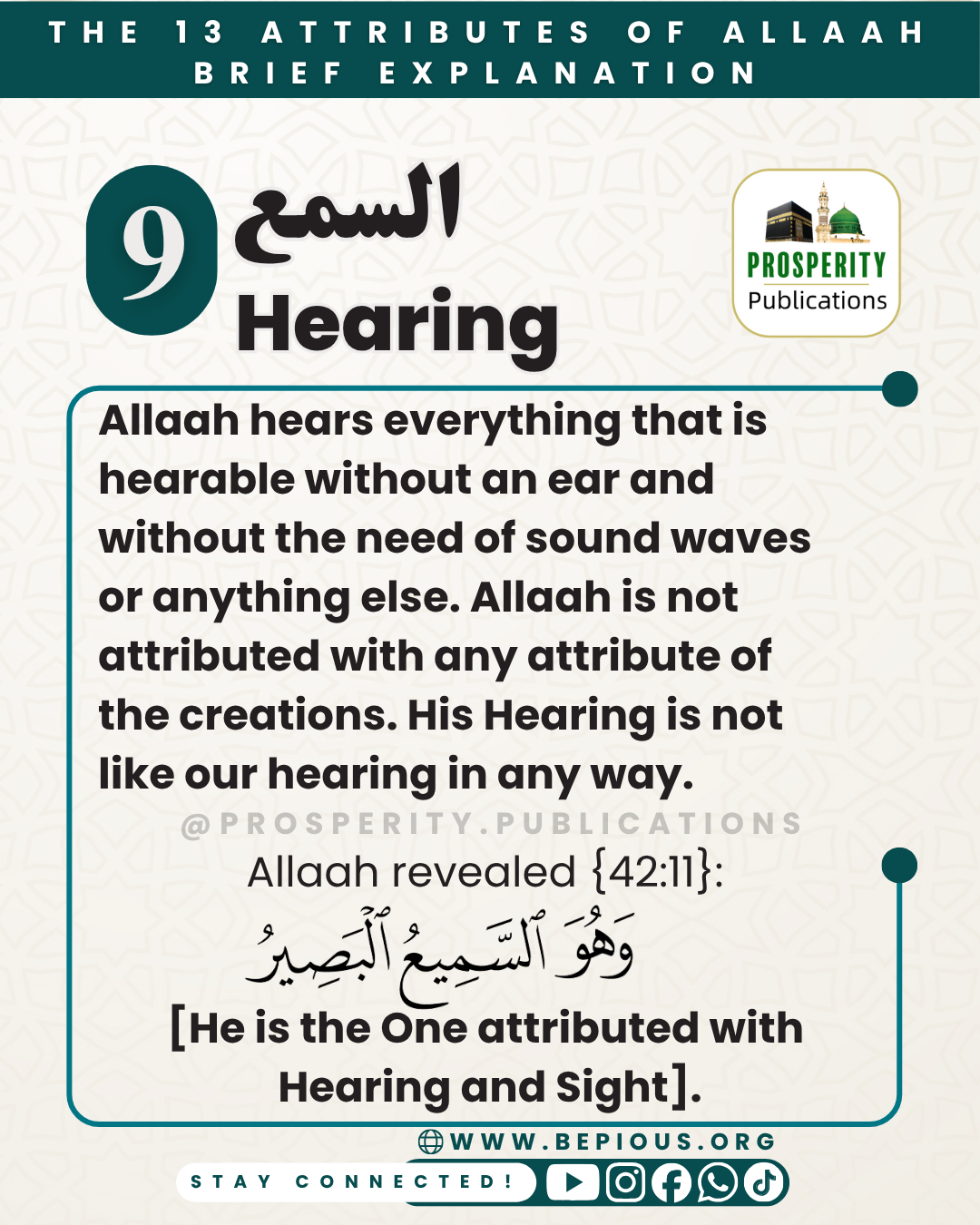
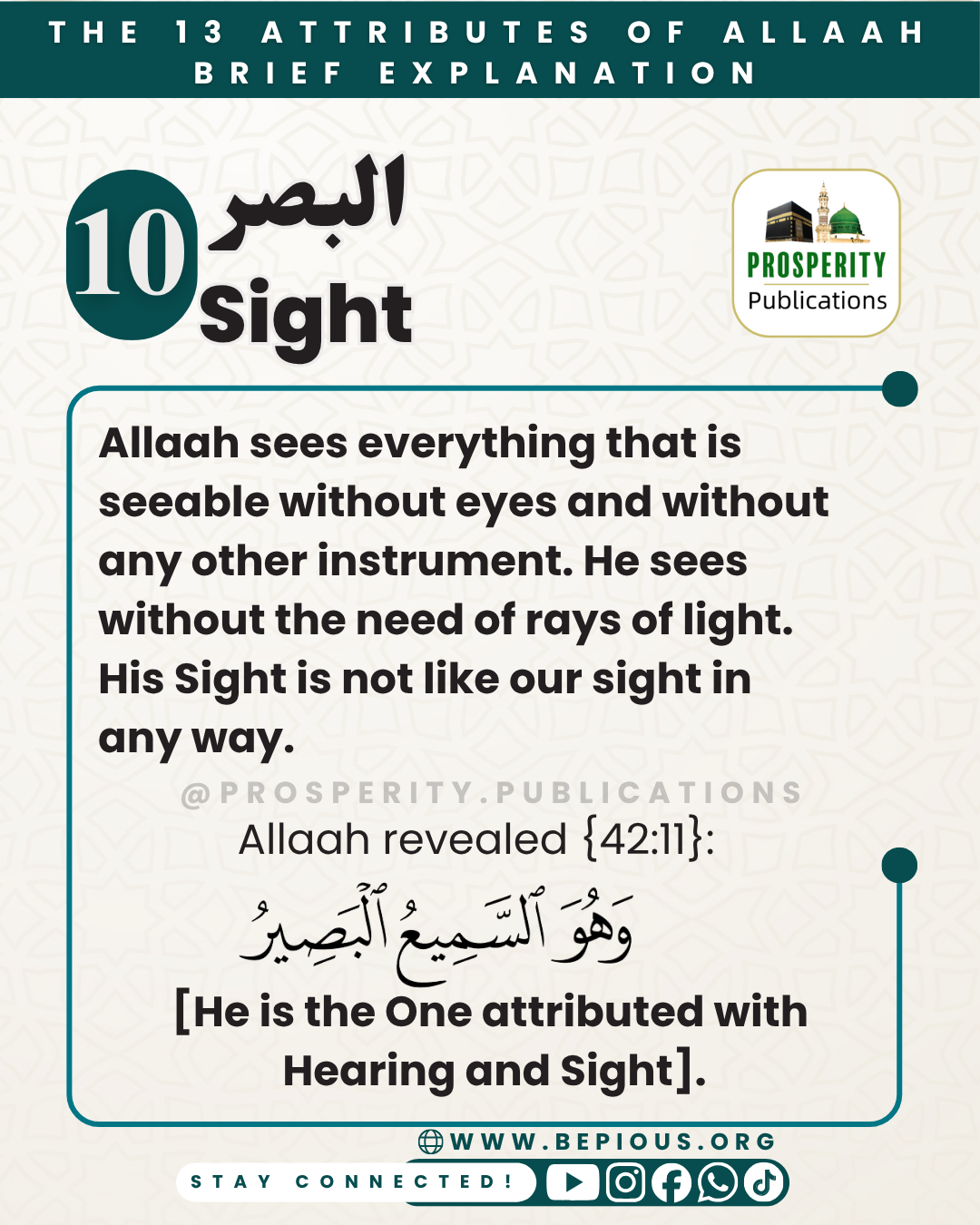
There is absolutely nothing like Him, and He is attributed with Hearing and Sight
There is absolutely nothing like Him, and He is attributed with Hearing and Sight
Explanation:
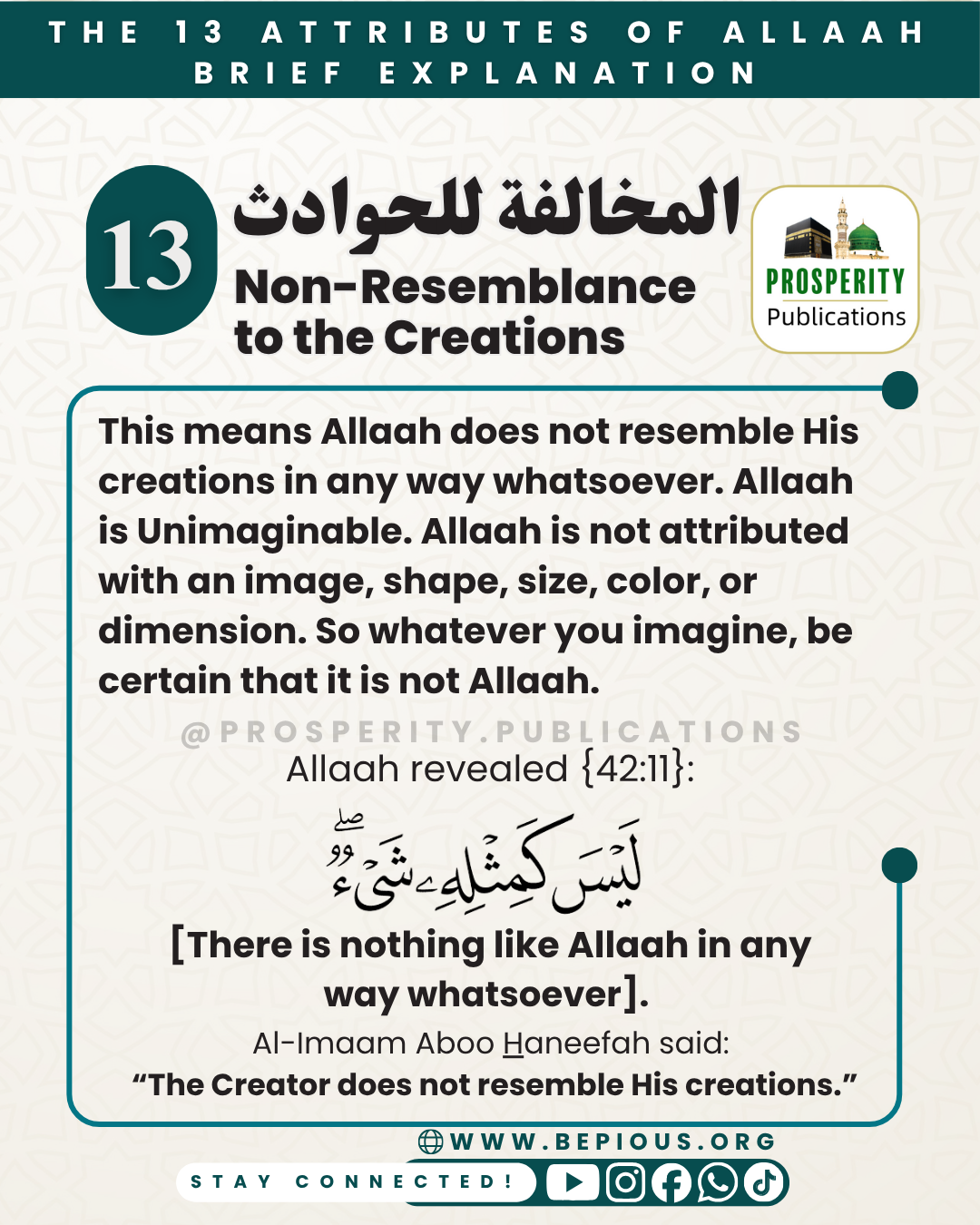
This is the meaning of verse 11 of Soorat Ash-Shooraa
﴿ لَيْسَ كَمِثْلِهِۦ شَىْءٌۭ ﴾
It means that nothing resembles Allaah in any way.
The noble scholars Imaam Ahmad Ibnu Hanbal and Dhun-Noon Al-Misriyy, may Allaah raise their ranks said :
مَهْمَا تَصَوَّرْتَ بِبَالِكَ فاللهُ بخلافِ ذلكَ
“Whatever you imagine in your mind, Allaah is not like it (in any way).”
Allaah is clear of resembling any of the creations, tangible or otherwise. For example, Allaah is different from the humans, angels, light, souls, sun, and moon. Allaah is not similar to any of the creations in any way whatsoever.
Allaah exists without a beginning and everything else exists with a beginning. He is the Creator and everything else is a creation
Allaah exists without a beginning and everything else exists with a beginning. He is the Creator and everything else is a creation.
Explanation:
Allaah is the only One Who is eternal. Hence, Allaah is the only One Whose Existence is without a beginning. Everything else exists with a beginning. This is the meaning of a creation, i.e., the creation is that which was not existing and then it was brought into existence. Therefore, there was a beginning to its existence.
Everything other than Allaah is a creation and is created by Allaah, the Exalted. This applies to the kind¹ and the elements, the deeds and the bodies, and the jawhar² and the ^arads³.
- ¹ The kind is the common criterion existing in each and every element of a group which specifically characterizes that group. For example, humanity is the ‘kind’ of the humans.
- ² The jawhar refers to the smallest particle that cannot be further divided.
- ³ The ^arad refers to the attribute that does not exist independently.
The belief that everything other than Allaah is a creation is amongst the fundamentals of the creed of the Muslims. Hence, anyone who believes that something other than Allaah exists without a beginning is a blasphemer.
Some people believe the kind of the universe is eternal (that its existence has no beginning) just like the later philosophers and Ahmad Ibn Taymiyah said. In his book, Tashneef al-Masaami^, Az-Zarkashiyy narrated the consensus of the Muslims judging those who believe the universe is eternal to be blasphemers.
Every creation that exists, be it amongst entities or deeds, from the fine dust to the ^Arsh, and every movement, rest, intention, and thought of the slaves is created by Allaah
Every creation that exists, be it amongst entities or deeds, from the fine dust to the ¹^Arsh, and every movement, rest, intention, and thought of the slaves is created by Allaah. Hence, no one other than Allaah-be it nature or cause creates anything. Things become existent by Allaah’s Will, Power, and Destining, and in accordance with His eternal Knowledge.
¹The ^Arsh is the ceiling of Paradise. It is the largest of the creations in size, having four legs. Some refer to it in English as ‘the Throne’
Explanation:
The nature of things means their specific normal characteristics (tabee^ah) or ^aadah, as some scholars said. For example, the nature (tabee^ah) of fire is to burn. The cause (^illah) is what gives a certain result. For example, if one has a ring on one’s finger and moves one’s finger, the ring moves because of the movement of one’s finger. So, the movement of the finger is the cause (^illah) for the movement of the ring.
Neither the laws of nature nor causes create anything in this universe. Rather, Allaah is the only One Who creates. By His Power, Allaah brings things into existence. Allaah eternally knew about His creations and accordingly He willed for them to exist. Allaah is the Creator of everything.
As mentioned in the Qur’aan:
قال الله تعالى: ﴿ وَخَلَقَ كُلَّ شَىْءٍۢ ﴾
Soorat Al-Furqaan, verse 2 means: [Allaah created everything]. He brought all the creation from the state of non-existence into the state of existence. No one creates with this meaning of creating except Allaah.
قال الله تعالى: ﴿ هَلْ مِنْ خَـٰلِقٍ غَيْرُ ٱللَّهِ ﴾
Soorat Faatir, verse 3 means: [No one is the Creator except Allaah].
An-Nasafiyy said that if a person hit glass with a stone and broke it, then the acts of hitting and breaking and the state of being broken were created by Allaah. The slave only acquires the act. Allaah is the only One Who creates.
قال الله تعالى: ﴿ لَهَا مَا كَسَبَتْ وَعَلَيْهَا مَا ٱكْتَسَبَتْ ﴾
Soorat Al-Baqarah, verse 286 means: [Every individual self will be rewarded by Allaah for the good deeds it acquired and will be accountable for the sins it committed].
Explanation:
The creed of the People of Truth, Ahlus-Sunnah wal-Jamaa^ah, is that the slave is a creation of Allaah, and the doings of the slave are also creations of Allaah. The slave does not create anything.
Allaah is the One Who creates the doings of the slave, and the slave only acquires his acts. So, if a person picks a stone from the ground, throws it at a piece of glass and breaks the glass, then breaking the glass by throwing the stone (which is the action of the slave) and the breaking of the glass (which occurs in the glass) are both created by Allaah. Moreover, the slave’s intention to throw that stone at the glass, the hand by which he threw the stone, the action of throwing, and the stone he threw are all created by Allaah. All that happens is a creation of Allaah. Even one’s intentions, desires, inclinations, thoughts, and any changes in them are created by Allaah.
As related by Al-Bayhaqiyy and others, the Prophet, ﷺ, said:
إِنَّ قُلُوبَ العِبَادِ بَيْنَ إِصْبَعَينِ مِنْ أَصَابعِ الرَّحمٰنِ يُقَلِّبُهَا كَيْفَ يَشَاءَ
It means: The hearts of the slaves are under the control of Allaah. Allaah turns them the way He willed.
Hence, the one who deviates from this belief and claims that the slaves create their own voluntary actions is belying the Qur’aan and the hadeeth. This is why the top scholars hold the consensus that such a person is a blasphemer. Imaam Al-Maatureediyy declared them as blasphemers. Aboo Mansoor Al-Baghdaadiyy said:
أَجْمَعَ أَصْحَابُنَا عَلَى تَكْفِيرِهِم
“The Ash^ariyys are in agreement that such people [those who claim people create their own actions] are blasphemers.” Before them, many prominent scholars of the Salaf¹ declared as blasphemers those who say the slave creates his deeds. First and foremost, the Prophet, ﷺ, declared them as blasphemers, and the sayings of the Prophet, ﷺ, are sufficient.
However, saying that Allaah is the Creator of everything, including the intentions of the slave, does not mean that the slave does not have a choice. The slave has a choice; however, his choice is under the Will of Allaah. His choice does not reach to an extent that he creates his own actions. Rather his own choice is a creation of Allaah and is under the Will of Allaah.
¹The Salaf are the Companions, their followers, and their followers who lived within the first 300 Hijriyy years.
Beneficial Information: “The slave acquires his act” means that he directs his will and intention towards doing a particular deed, then Allaah creates that deed. Although the directing of the will and the doing of the deed are created by Allaah, still the slave is doing the directing and the deed-therefore he acquires his act. Hence, if someone runs intentionally, the fact that his intention and his running movements are created by Allaah does not negate that he is the one running intentionally, and thus, that he is accountable for his running.
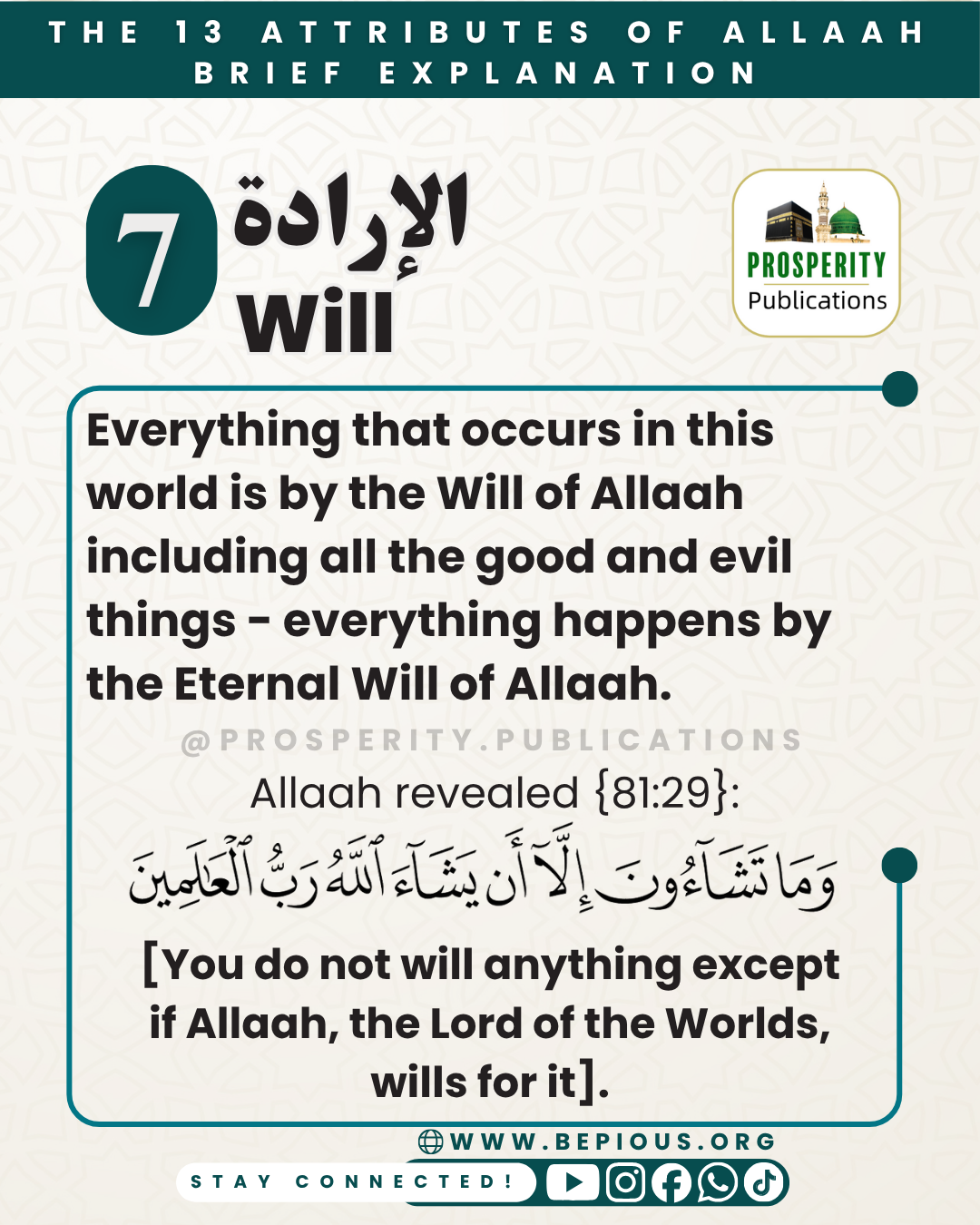
Beneficial Information: The Will of Allaah is the attribute by which Allaah specifies the intellectual possibilities (the creations) with their attributes.
The Speech (Kalaam) of Allaah is without a beginning like all of His other attributes, because He, the Exalted, is unlike all the creations in the Self (Dhaat), Attributes, and Acts
The Speech (Kalaam) of Allaah is without a beginning like all of His other attributes, because He, the Exalted, is unlike all the creations in the Self (Dhaat), Attributes, and Acts.
Explanation:
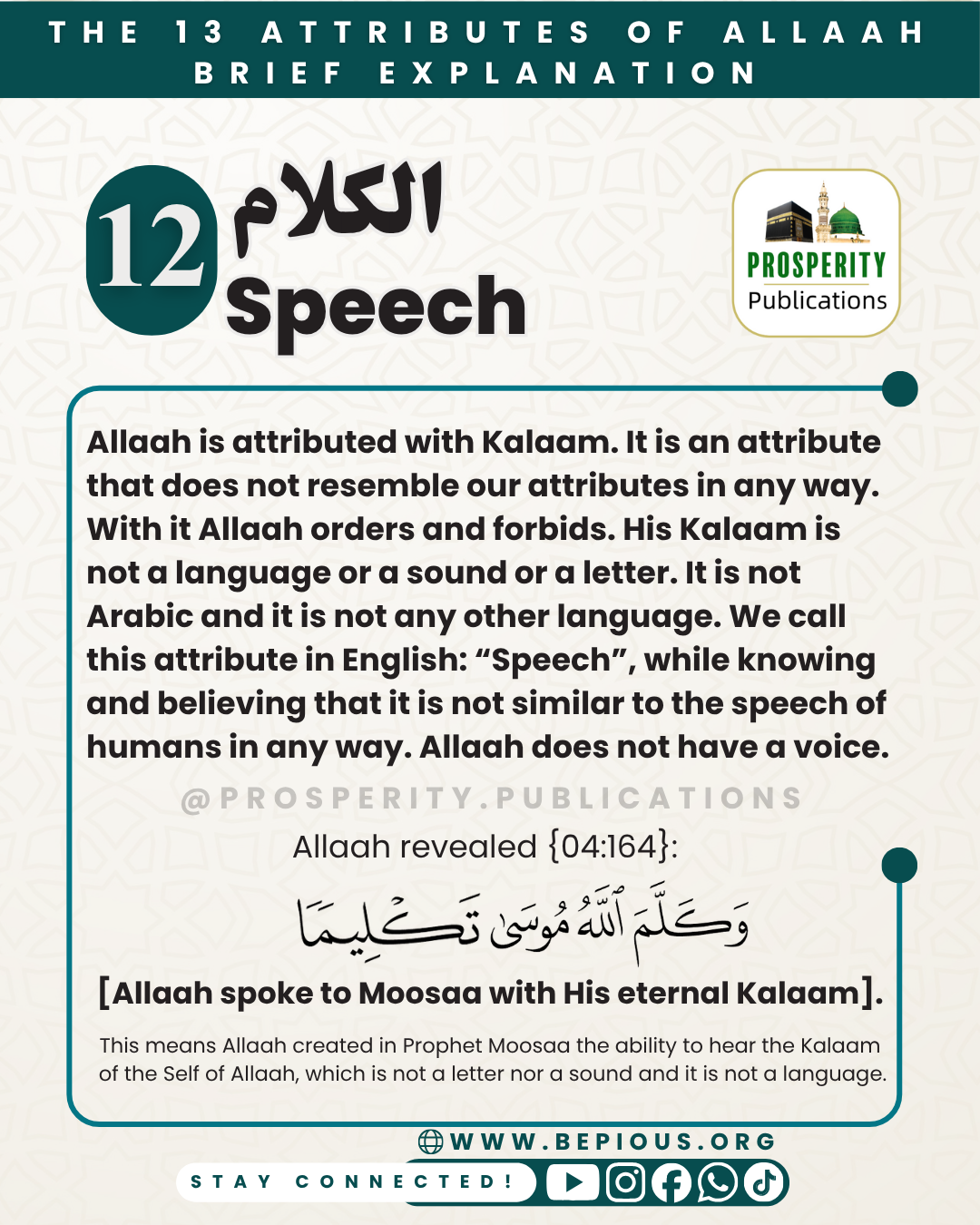
The Speech (Kalaam) of Allaah which is the attribute of His Self is eternal, i.e., it has no beginning, just like all the other attributes of Allaah. It does not have a beginning or an ending. It is not letters which occur sequentially. The Speech of Allaah is not similar to the speech of the creation.
The eternal Speech (Kalaam) of Allaah is called ‘the Qur’aan’ The term ‘the Qur’aan’ can also refer to the terms revealed to Prophet Muhammad, ﷺ, and included in the Book of the Qur’aan. These Arabic terms are created. Because these terms are expressions referring to the eternal Speech of Allaah; they are also called ‘the Qur’aan’ even though, beyond doubt, these terms are created.
To make it more clear, if someone wrote the word ‘Allaah’ on a chalkboard and was asked what it was he wrote, he would answer, ‘Allaah’ His response does not mean those letters he wrote, i.e., the A, L, L, A, and H are the Self Whom we worship (Allaah). Rather, he means that this term is an expression referring to the Self Whom we worship-Who is Allaah, the Self Who does not resemble anything.
Likewise, the terms revealed to Prophet Muhammad, ﷺ, are expressions of the Speech of Allaah, the attribute of His Self. Both the attribute of the Self of Allaah and the revealed expressions are referred to as the ‘Speech of Allaah’ and both are referred to as ‘the Qur’aan.’
It is not permissible for one to believe that the Speech of Allaah, which is the attribute of His Self, the Speech which Prophet Moosaa ^alayhis-salaam heard, is a language – Arabic or otherwise. Such a belief is misguidance, because it entails likening Allaah to the creatures. Allaah is absolutely unlike all the creations in His Self, in His Attributes, and in His Acts.
Allaah, subHaanahoo wa ta^aalaa, is greatly clear of all the unbefitting attributes that the blasphemers attribute to Him
Allaah, subhaanahoo wa ta^aalaa, is greatly clear of all the unbefitting attributes that the blasphemers attribute to Him.
Explanation:
Subhaanahoo means tanzeeh, i.e., we declare that Allaah is clear of all unbefitting attributes. Ta^aalaa means the same and is a re-confirmation of the same meaning. Allaah is greatly clear of all the unbefitting attributes that the blasphemers attribute to Him.
The 13 Attributes of Allaah, the Exalted
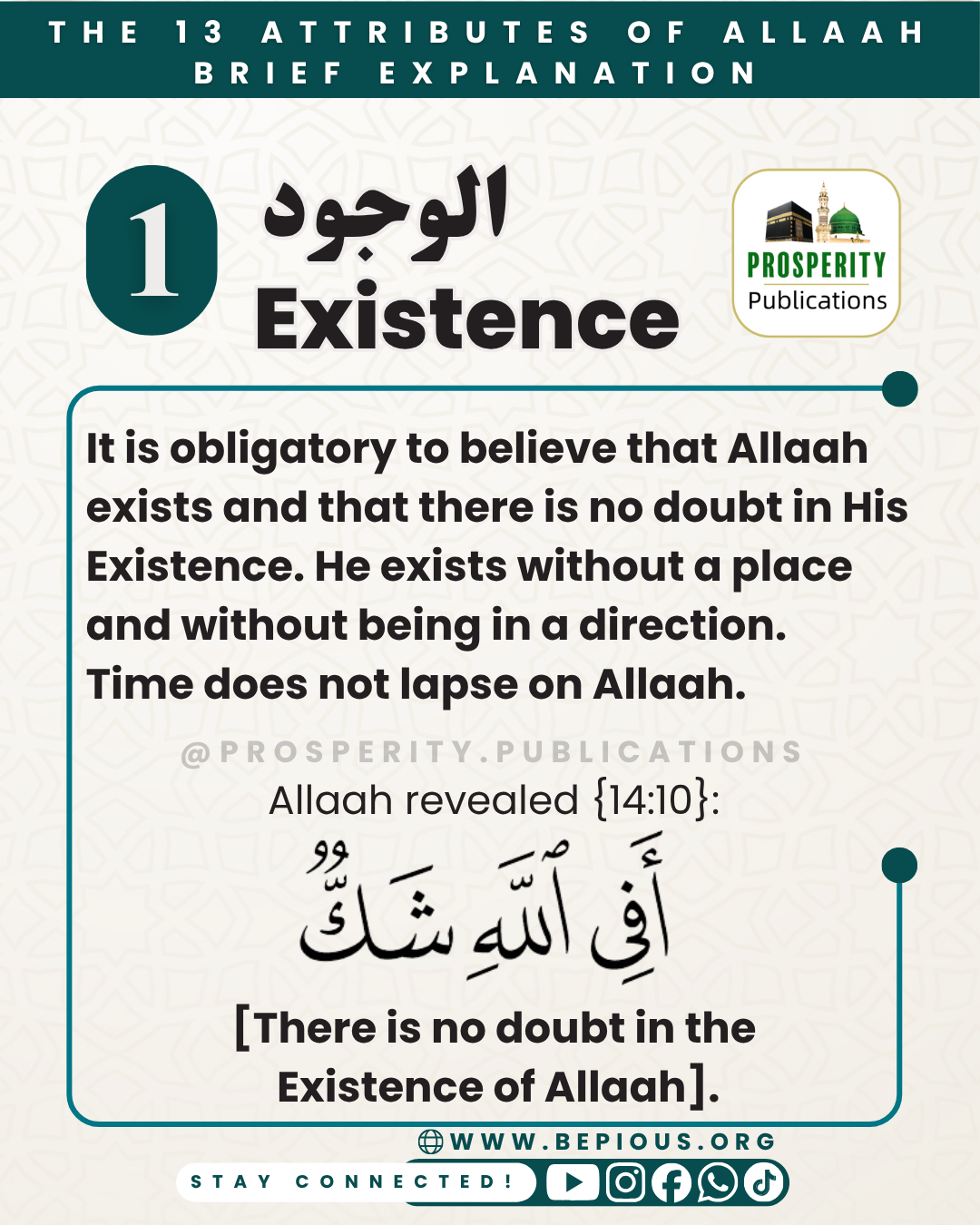
Summing up what has been mentioned before, it is affirmed that Allaah, the Exalted, has thirteen (13) attributes which were mentioned repeatedly in the Qur’aan, either explicitly or implicitly.
The scholars said that it is obligatory upon every accountable person (mukallaf) to know specific thirteen Attributes of Allaah.
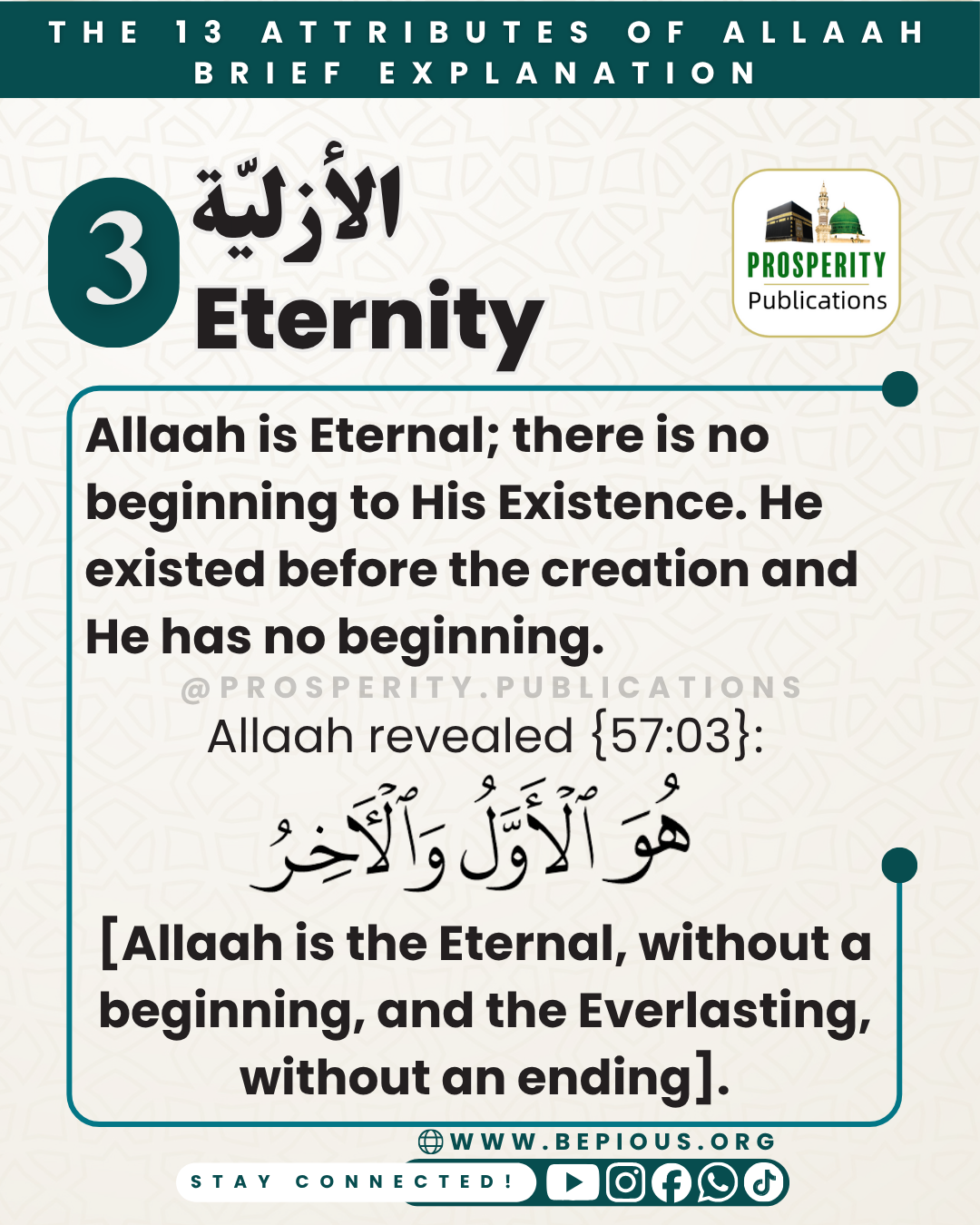
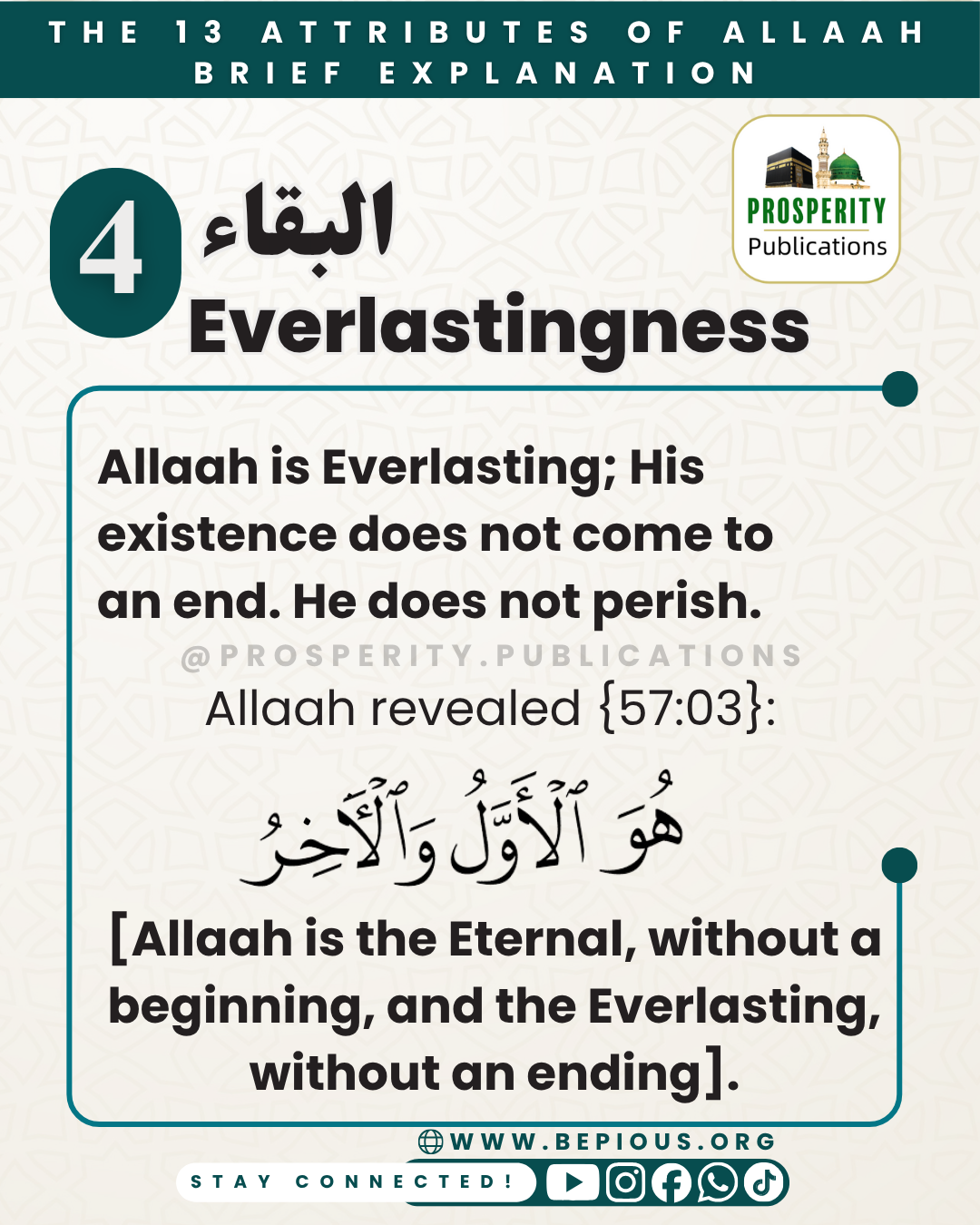
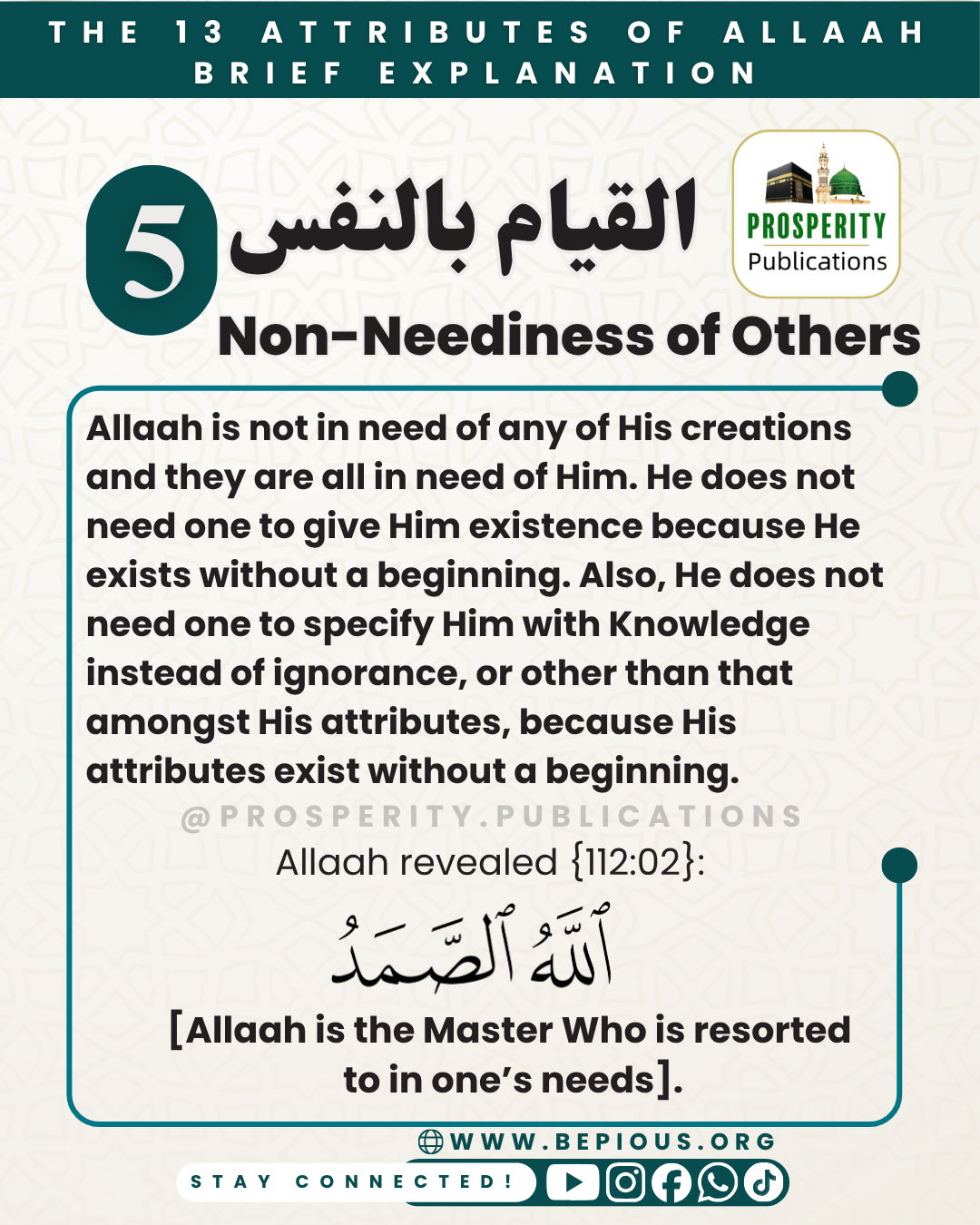
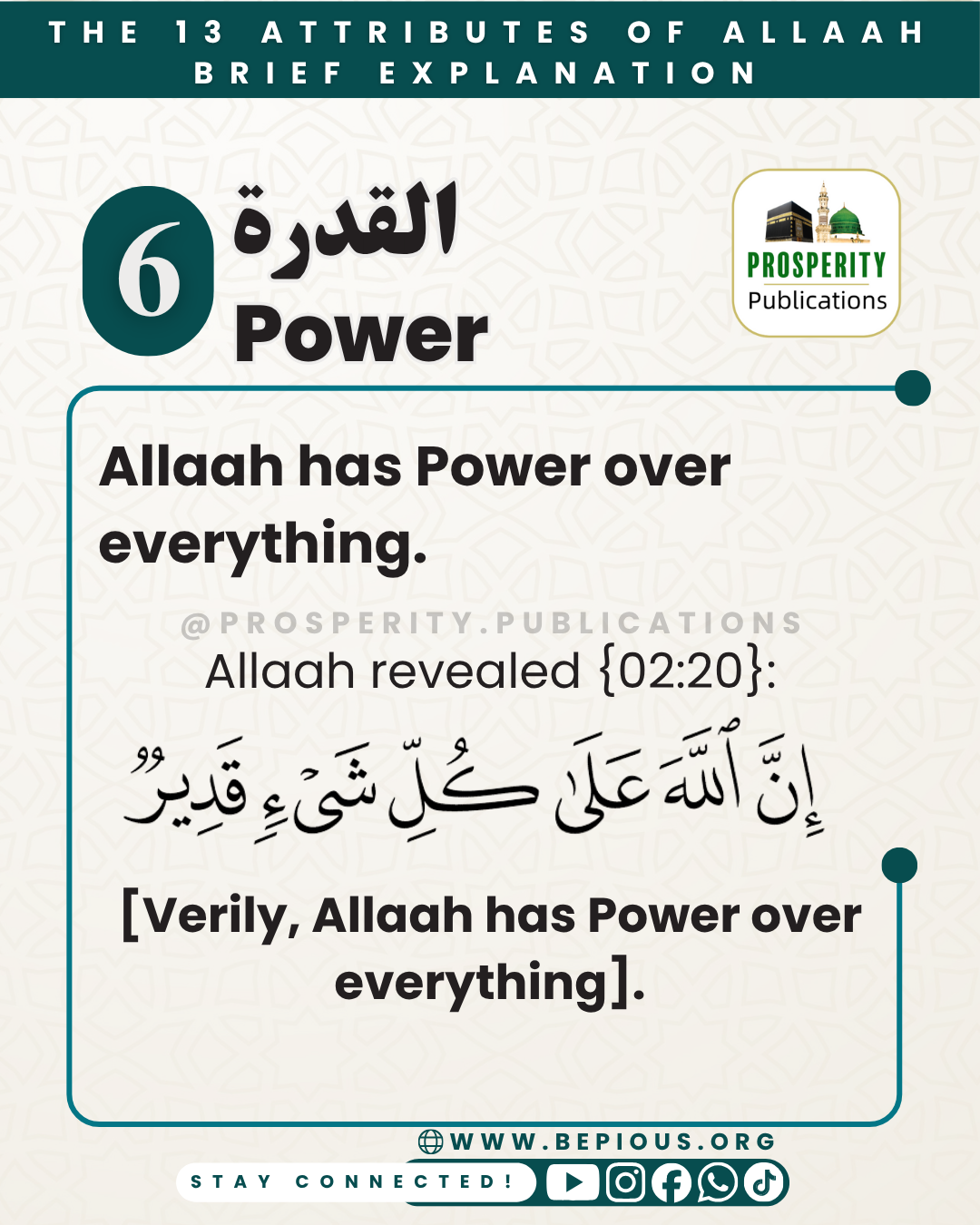
They are: Existence, Uniqueness, Eternity, Everlastingness, Non neediness of others, Power, Will, Knowledge, Hearing, Sight, Life, Speech, and Non-resemblance to the creations.
The explanation of these attributes is as follows below:
The Meaning of Ash-hadu anna Muhammadar-Rasoolullah
The meaning of Ash-hadu anna Muhammadar-Rasoolullaah is: ” I know, believe, and declare that Muhammad, the son of ^Abdullaah, who is the son of ^ Abdul-Muttalib, who is the son of Haashim, who is the son of ^Abdu-Manaaf, from the tribe of Quraysh, ﷺ, is the slave of Allaah and His Messenger to all the humans and jinn.”
Explanation:
Prophet Muhammad, ﷺ, is from the clan of Haashim, i.e., his lineage goes back to Haashim, the son of ^Abdu Manaaf.
The clan of Haashim is a branch of the tribe of Quraysh. Quraysh is the tribe with the highest rank amongst the Arab tribes. The tribe of Quraysh goes back in lineage to Prophet Ismaa^eel ^alayhis-salaam, the son of Prophet Ibraaheem ^alayhis-salaam.
Knowing the lineage of the Prophet back to ^Abdu Manaaf is a communal obligation (fard kifaayah). Prophet Muhammad, ﷺ, is the slave of Allaah and His Messenger to all humans and jinn. He was not sent only to the Arabs or only to the non-Arabs, or solely to the humans.
One must believe he was born in Makkah and sent as a Messenger therein; he immigrated to al-Madeenah and was buried therein; and he was truthful in everything he told about and conveyed from Allaah
One must believe he was born in Makkah and sent as a Messenger therein; he immigrated to al-Madeenah and was buried therein; and he was truthful in everything he told about and conveyed from Allaah.
Explanation:
Prophet Muhammad, ﷺ, was born in Makkah in the Year of the Elephant, the year when Abrahah led an army and some elephants in an (unsuccessful) attempt to destroy the Ka^bah. Allaah destroyed Abrahah and his army, as described in the Qur’aan in Sooratul-Feel.
He first received the Revelation in Makkah when he was forty (40) years old. He stayed in Makkah for thirteen (13) years after receiving the Revelation, then immigrated to al-Madeenah and lived there for ten (10) years. He died and was buried in al-Madeenah in Lady ^Aaishah’s chamber in the eleventh (11th) year after the hijrah. He was sixty-three (63) years old.
Knowing that Prophet Muhammad, ﷺ, was born in Makkah and died in al-Madeenah is an important matter; there is a big probability for this to be amongst the Personal Obligatory Knowledge.
Amongst what the Prophet, ﷺ, informed us are: the torture in the grave and the enjoyment therein; the questioning of the two angels, Munkar and Nakeer
Amongst what the Prophet, ﷺ, informed us are: the torture in the grave and the enjoyment therein; the questioning of the two angels, Munkar and Nakeer
Explanation:
After the person is buried, his soul which separated from his body at death, returns to his body. Two angels come to him. One angel is named Munkar and the other named Nakeer. They will ask the dead person about his Lord, his Prophet, and his Religion. They have a frightening appearance. The blasphemer will be extremely frightened of them. However, the God-fearing believer does not fear them.
The people in their graves are two types.
One type experience enjoyments in the grave.
Their graves are widened and illuminated. These are the obedient and forgiven Muslims.
The other type will be tortured in their graves, and these are also two categories.
One are the blasphemers who will face the torture of the grave continually until their bodies decay. Then after their bodies decay, their souls will be taken to a place in the seventh earth called Sijjeen, where they will be tortured until the Day of Judgment.
The other category are the sinful Muslims whom Allaah did not forgive. They will be tortured in their graves for a certain period. However, the torture will not continue for them until the Day of Judgment. Once their bodies decay, their souls are suspended between the Earth and the sky. They face their remaining torture which they deserve in the Hereafter (except those whom Allaah forgives).
Believing in the torture of the grave and the enjoyments of the grave is an obligation. The one who categorically denies the torture of the grave is a blasphemer.
Resurrection (Ba^th)
Resurrection (Ba^th).
Explanation:
The Resurrection is the rising of the dead from their graves. One must believe in the Resurrection. Allaah recreates the bodies that decayed and returns the souls to them. Then the dead will rise out of their graves.
Assembly (Hashr)
Assembly (Hashr)
Explanation:
After the Resurrection, the humans, animals, and jinn will be assembled (gathered by the angels) to one place (the changed Earth).
The Day of Judgment (Qiyaamah)
The Day of Judgment (Qiyaamah)
Explanation:
It is obligatory to believe in the Day of Judgment. Its length is 50,000 years of what we count. The Day of Judgment begins when the people leave their graves and lasts until those whom Allaah willed for them to go to Paradise enter it, and those whom Allaah willed for them to go to Hellfire enter it.
Presentation of the Deeds (Hisaab)
Presentation of the Deeds (Hisaab)
Explanation:
This means that on the Day of Judgment every person will be presented with one’s deeds. Every person will be handed one’s book in which the angels wrote what one did in this life. On that day, some will be delighted with their books and others will be sad.
Reward (Thawaab)
Reward (Thawaab)
Explanation:
The Reward refers to the reward for the believers in the Hereafter, in return for the good things they did in this life. This reward is by both body and soul.
Punishment (^Adhaab)
Punishment (^Adhaab)
Explanation:
The Punishment refers to the punishment that one receives in the Hereafter in return for the sins one did in this life. The Punishment is also by body and soul.
The Balance (Meezan)
The Balance (Meezan)
Explanation:
In the Hereafter, the deeds of the people will be weighed on a balance. The good deeds will be weighed in one pan and the bad deeds in the other. If the pan of the good deeds is heavier than the pan of the bad ones, the person is a winner. One will be saved. If the pan of the bad deeds is heavier, then one deserves punishment. On the Day of Judgment, the blasphemer will have nothing in the pan for the good deeds.
Hellfire (Naar)
Hellfire (Naar)
Explanation:
Hellfire is a place where the blasphemers and part of the sinful Muslims are tortured in the Hereafter. It is a physical fire, extremely hot; it does not get extinguished and it does not come to an end. The blasphemers stay in continuous torture in Hellfire. Their torture will never lessen or stop. However, the sinful Muslims who enter Hellfire do not remain there endlessly. They eventually will be taken out and admitted into Paradise. They will not remain in Hellfire, because Allah does not equate between the Muslim and the blasphemer.
The Bridge (Siraat)
The Bridge (Siraat)
Explanation:
It is obligatory to believe in the Bridge (Siraat). It is a bridge stretching over Hellfire to which all the humans will come. It begins at the changed Earth and ends before Paradise. Some fall into Hellfire at the very beginning of the bridge and these are the blasphemers. Some of the believers walk on the Bridge, then fall into Hellfire. The rest are saved.
The Basin (HawD)
The Basin (Hawd)
Explanation:
The basin of our Prophet, ﷺ, is a huge body of water. Its water comes from the water of Paradise. Every prophet has a basin from which his nation drinks. The nation of Prophet Muhammad, ﷺ, drinks from his Basin before entering Paradise. May Allaah grant us that.
The Intercession (Shafaa^ah)
The Intercession (Shafaa^ah)
Explanation:
Intercession is defined as asking for good things of someone for others. In the Hereafter, the prophets, the pious Muslims, the angels, and the martyrs intercede for some of the sinful Muslims, and as a result, they will be forgiven by Allaah. Prophet Muhammad, ﷺ, performs the major intercession.
On the Day of Judgment, the sinful Muslims go to Prophet Aadam ^alayhis-salaam to ask him to intercede for them to be relieved from the extreme heat of the sun. He directs them to Prophet Nooh ^alayhis-salaam saying, “He is your father after your father.” Prophet Nooh ^alayhis-salaam directs them to go to Prophet Ibraaheem ^alayhis-salaam who directs them to Prophet Moosaa ^alayhis-salaam who directs them to Prophet ^Eesaa ^alayhis-salaam, who in turn directs them to Prophet Muhammad, ﷺ, who intercedes for them.
Paradise (Jannah)
Paradise (Jannah)
Explanation:
It is an obligation to believe in Paradise, which is now existing. Paradise is above the seventh sky. The ceiling of Paradise is the ^Arsh (Throne) and is much larger than Paradise. Paradise has many levels. Its uppermost level is called the Firdaws and the ^Arsh is above it.
Seeing Allaah, the Exalted, with the eye in the Hereafter, without Allaah having a form or being in a place or a direction, different from the way a creation is seen
Seeing Allaah, the Exalted, with the eye in the Hereafter, without Allaah having a form or being in a place or a direction, different from the way a creation is seen
Explanation:
This is a known element of the creed of Muslims and is a point of difference between the people of Ahlus-Sunnah and some deviant factions. We must believe that the believers, while in Paradise, see Allaah with their eyes. Allaah empowers their eyes to see Him. They will see Allaah not the way the creatures are seen rather they see Allaah without Allaah being in a direction. They see Allaah without having a distance between them and Him. This was explicitly stated by Imaam Aboo Haneefah in Al-Fiqh Al-Akbar, and other scholars. Seeing Allaah is the greatest enjoyment the occupants of Paradise will experience. May Allaah grant us this.
The dwelling forever in Paradise or Hellfire
The dwelling forever in Paradise or Hellfire
Explanation:
It is obligatory to believe that the blasphemers will dwell forever in Hellfire, and those who enter Paradise will be there forever. This was explicitly stated in the Qur’aan and explicitly mentioned in the hadeeth of the Prophet, ﷺ. This is a matter which is known to both the scholars and the lay Muslims.
The belief in Allaah's Angels
The belief in Allaah’s Angels
Explanation:
It is obligatory to believe in the angels, i.e., to believe that they exist. They are bodies which Allaah created from light. They are not males or females. They do not eat or drink. They are never disobedient to Allaah; they always obey His orders.
Messengers
Messengers
Explanation:
We must believe in all the Prophets, those of whom we know and those of whom we do not know. They were numerous.
The first of them was Aadam ^alayhis-salaam. The last was our Prophet, Muhammad, ﷺ.
Some of them were Prophets and Messengers and others were Prophets but not Messengers.
The Prophet, who is a Messenger, is one to whom Allaah revealed new Laws differing from the Laws of the Messenger before him.
The Prophet who was not a Messenger also received the Revelation from Allaah, in which he was ordered to follow the Laws of the Messenger before him. Both the Prophets and the Messengers were ordered to convey their message.
Some falsely defined the Prophet who is not a Messenger as: “the one who received the Revelation of a new set of laws but was not ordered to convey them to others.” This is a serious error which one categorically must not adopt.
Books
Books
Explanation:
It is obligatory to believe in all the Revealed Books. They are one hundred and four. The most famous are four: the Tawraah, the Zaboor, the Injeel, and the Qur’aan.
Other than these four famous Books, it is narrated that fifty different sheets were revealed to Prophet Sheeth ^alayhis-salaam, thirty to Prophet Idrees ^alayhis-salaam, ten to Prophet Ibraaheem ^alayhis-salaam, and ten other than the Tawraah to Prophet Moosaa ^alayhis-salaam.
Destining (Qadar), whether the destined (qadar) is good or evil
Destining (Qadar), whether the destined (qadar) is good or evil
Explanation:
The Arabic term qadar can mean ‘destining’ and it can mean destined. It is obligatory to believe that everything that happens in this universe happens according to the Will of Allaah, by the Creating of Allaah, and by the Destining (Qadar) of Allaah. Destining, when used to mean the eternal attribute of Allaah, means Allaah’s managing things and making them occur in accordance with His eternal Will and Knowledge. In other words, it is making things the way they are.
However, destined (qadar) is used in the above text to mean the created thing. It refers to that which happens according to the Destining (Qadar) of Allaah. This is why it is divided into what is good and what is evil. It is not permissible to say about the Destining (Qadar) of Allaah which is the attribute of His Self, that some is good and some other is evil. The Destining (Qadar) of Allaah is good. However, as to that which happens, i.e., the created things, some of them are good and some of them are evil.
MuHammad, ﷺ, is the last of the Prophets and the best of all the children of Aadam
Muhammad, ﷺ, is the last of the Prophets and the best of all the children of Aadam.
Explanation:
Prophet Muhammad, ﷺ, is the last Prophet Allaah sent. No prophet will come after him. Although Prophet ^Eesaa, ^alayhis-salaam, will descend from the sky before the Day of Judgment, he received the Revelation of Prophethood before Muhammad, ﷺ, and when he descends, he will rule with the Laws of Prophet Muhammad, ﷺ, The last revealed Prophet is Prophet Muhammad, ﷺ, as was clearly stated in the Qur’aan in Soorat Al-Ahzaab, verse 40 which specifically says that Prophet Muhammad ,ﷺ ,is the last of the prophets:
﴿ مَّا كَانَ مُحَمَّدٌ أَبَآ أَحَدٍۢ مِّن رِّجَالِكُمْ وَلَـٰكِن رَّسُولَ ٱللَّهِ وَخَاتَمَ ٱلنَّبِيِّـۧنَ ﴾
It means: [Muhammad is not the father of any of your men, rather he is the Messenger of Allaah and the seal of the Prophets.] Anyone who claims that a prophet will be revealed after Prophet Muhammad, ﷺ, a blasphemer.
For example, there are some who claim that a man by the name of Ghulam Ahmad received Prophethood after Prophet Muhammad ﷺ. Ghulam Ahmad is from Qaadiyaan and lived about 100 years ago. He claimed Prophethood for himself, and some misguided people believed him. His followers are known as the Qaadiyaaniyyah. Sometimes, they refer to themselves as Ahmadiyyah. They are blasphemers for believing in the religious permissibility of some people receiving the Revelation after Prophet Muhammad ﷺ.
Moreover, our Prophet Muhammad ﷺ, is the best of all the prophets. After him in status are Prophets Ibraaheem ^alayhis-salaam, then Moosaa ^alayhis-salaam, then ^Eesaa ^alayhis-salaam, then Nooh ^alayhis-salaam. May Allaah raise their ranks all.
It is obligatory to believe that every Prophet of Allaah must be attributed with truthfulness, trustworthiness, and intelligence
It is obligatory to believe that every Prophet of Allaah must be attributed with truthfulness, trustworthiness, and intelligence.
Explanation:
This means that every Prophet of Allaah is truthful. A Prophet does not lie-not even one single lie -neither before Prophethood nor after Prophethood. Every one of them is trustworthy. He does not betray, neither before Prophethood nor after Prophethood. Every one of them is intelligent and able to produce the proofs to discredit the blasphemous creeds and the unlawful doings. The Prophets are the most intelligent of all the creations.
Lying, dishonesty, vileness, foolishness, dullness, cowardice, and all qualities that repel people from accepting the call from them are impossible to be amongst their attributes
Lying, dishonesty, vileness, foolishness, dullness, cowardice, and all qualities that repel people from accepting the call from them are impossible to be among their attributes.
Explanation:
A Prophet does not commit any vileness, such as using obscenities frequently. He does not act in a stupid manner; it is impossible that any of the Prophets of Allaah be attributed with dullness. As well, the Prophets of Allaah are clear of repulsive attributes which detract others from them-whether in their manners or in their bodies. Hence, they are clear of all diseases which disgust others. They are clear of cowardice, rather they are the bravest. They are clear of withholding the message which Allaah ordered them to convey.
They must also be attributed with impeccability, ie., they are protected from ever committing blasphemy, enormous sins (kabaa^ir), and the small, abject sins before and after Prophethood
They must also be attributed with impeccability, ie., they are protected from ever committing blasphemy, enormous sins (kabaa^ir), and the small, abject sins before and after Prophethood.
Explanation:
No Prophet of Allaah ever committed blasphemy – neither before nor after Prophethood. What some claim about Prophet Ibraaheem ^alayhis-salaam, i.e, that at one point in time he worshipped the star, then the moon, then the sun, is a total fabrication. Prophet Ibraheem ^alayhis-salaam never worshipped other than Allaah. The verse in the Qur’aan some try to use to back their false statement does not have that meaning. When Prophet Ibraaheem, ^alayhis-salaam, said ‘haadhaa Rabbi’ ﴿ هٰذا رَبّى ﴾ (referring to the sun, moon, and star) he was not stating his agreement with his people in worshipping those things.
Rather his statement was to negate and oppose what they said. This is a form of expression in Arabic, called negative interrogative (استفهام إنكاري)
(i.e., a way of expressing one’s strong denial of a matter by posing a question which clearly shows that the matter is ridiculous or totally unacceptable.)
Likewise, Prophets are protected from committing enormous sins, both before and after Prophethood. Hence, when Moosaa ^alayhis-salaam killed that kaafir (non-Muslim) in Egypt, it was not an enormous sin. Moosaa ^alayhis-salaam neither intended to kill that man when he hit him nor thought he would die as a result of his punch. The reason Prophet Moosaa ^alayhis-salaam regretted his action was that he fought before he was ordered by Allaah to do so.
Prophets are also protected from committing small, mean sins, like stealing a morsel of bread or stealing a single grape. These are small sins, but they reflect a certain meanness. Prophets do not commit such sins both before and after Prophethood. From this, we know that the sin of Prophet Aadam ^alayhis-salaam was not an enormous sin. Rather, it was a small sin, that did not include meanness, as was stated by Imaam Al-Ash^ariyy and others.
On the other hand, they may commit other small sins. However, they are immediately guided to repent before others imitate them.
Explanation:
Prophets are not protected from committing a small sin which is not a mean one. However, should a prophet commit such a sin, he is immediately guided to repent of it before others follow him in doing it. As such, we know that the claim of some that Prophet Yoosuf wanted to fornicate with the woman of Al-^Azeez is totally untrue. Wanting this is a mean act and is unbefitting of a Prophet.
The verse 24 of Soorat Yoosuf:
﴿ وَلَقَدْ هَمَّتْ بِهِۦ ۖ وَهَمَّ بِهَا ﴾
which some use to try to back their false statement regarding Yoosuf does not mean that Prophet Yoosuf wanted to fornicate with her. In reality, this verse means that the woman attempted to adulterize with Prophet Yoosuf and that had he not been protected by Allaah, Who would later bestow Prophethood on him, he would have attempted to fornicate. This means that he did not attempt in the first place, because Allaah protected him by having eternally chosen him for the status of Prophethood. Looking lustfully at a marriageable woman is a matter the prophets do not commit, let alone committing the sin of attempting fornication.
Hence, Prophethood was not bestowed upon the brothers of Yoosuf, who, excluding Binyaameen, committed the mean deeds mentioned in the Qur’aan. The Asbaat are the descendants of Yoosuf’s brothers who were chosen for Prophethood.
Explanation:
The saying of some that the brothers of Yoosuf (other than Binyaameen) were given Prophethood is a false statement. Binyaameen was the youngest of Yoosuf’s brothers and his brother from both his father and mother. The others were Yusuf’s brothers from his father’s side only.
Binyaameen did not participate with them in the sinful deeds they did. This is why Binyaameen was famous to have received Prophethood Yoosuf’s brothers wanted to kill Yoosuf unjustly. They threw him in a well. Then they sold him, claiming he was a slave, when he was truly a free man. They humiliated their father, Ya^qoob, who was a Prophet and this is blasphemy. Although later they repented of these sins, none of them received the office of Prophethood. Prophets are protected from committing such wrong doings before Prophethood and after it. Some of the descendants of those brothers did receive Prophethood. Those descendants not Yoosuf’s brothers are the Asbaat mentioned in the Qur’aan (e.g., An-Nisaa’, 163) to be amongst the prophets.